

Skip to content
Brett's Ramblings Brett's Ramblings Brett's Ramblings
  • Home
  • My books
  • About me
  • Hire me.
  • Contact
  • Home
  • My books
  • About me
  • Hire me.
  • Contact
Close

Search

  • Home
  • My books
  • About me
  • Hire me.
  • Contact
Subscribe
Brett's Ramblings Brett's Ramblings Brett's Ramblings
  • Home
  • My books
  • About me
  • Hire me.
  • Contact
  • Home
  • My books
  • About me
  • Hire me.
  • Contact
Close

Search

  • Home
  • My books
  • About me
  • Hire me.
  • Contact
Subscribe

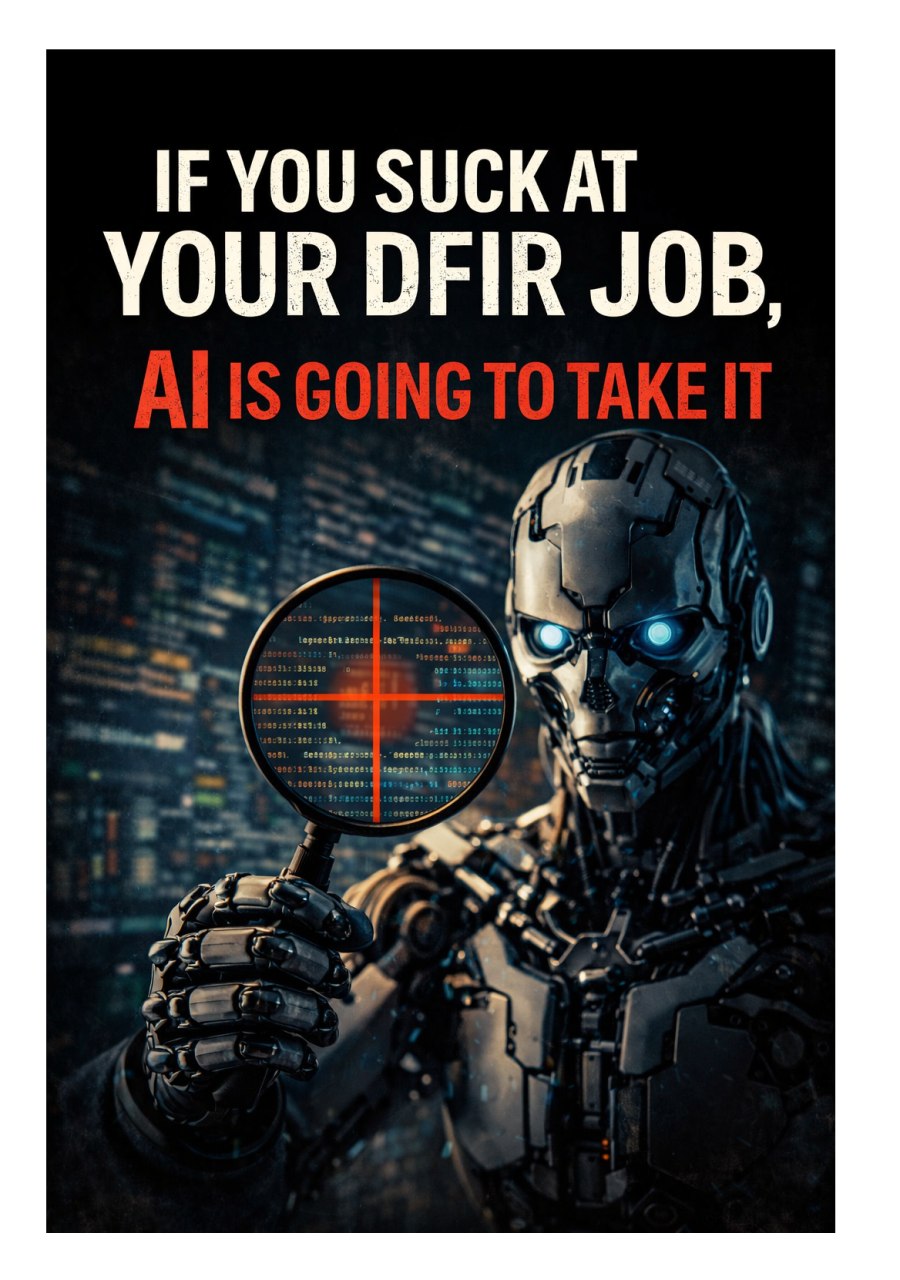
If you suck at your DFIR job, AI is going to take it.

By Brett Shavers
March 18, 2026
0

Some of you are on the X, and AI (via HR) has you in its crosshairs.

If your job is mostly clicking buttons, reading tool output, and turning machine data into paragraphs, you painted that target on yourself.

That kind of work is easy to model. Once it is modeled, it is easy to automate. And once it is automated, you are easy to replace.

So I’m going to help you get off the X.

I’m going to show you what AI takes first, why it takes those jobs first, and what you need to grab by the throat if you want to stay relevant when the easy work is gone.


Here it is:

If your value is data translation, you are in trouble.
If your value is event interpretation, you still matter (for the foreseeable future).

That’s your whole fight.


AI will take the translation work first

A lot of people in DFIR have been surviving on translation work while calling it analysis. The tool gives them data. They turn data into words, print the report, and call it a job well done.

That game of translation is ending, because translation work is the first thing getting fed to the machine. What many people call skill is often just repetitive keyboard labor signed off as expertise.

While some of you are still using AI to speed up your reports, other people are literally being paid to train these systems in their own field. 

That should bother you.

Read that again: We are training the machine to do our job. And that only means one thing: Your job. You are not hard to replace; you are simply more expensive to keep.

We spent so much time learning the tools that some of us became one. We learned the workflow, the buttons, the parser output, and the report template so well that we stopped acting like investigators and started acting like interfaces. If your value is behaving like a tool, don’t be surprised when a tool takes your job.

Lost in Translation

I’m writing this from Japan.

I speak some Japanese, and more importantly, I understand enough of the grammar and context to know when a literal translation says one thing while the actual meaning says something else. That is why Japanese is such a good example here. And yes, Lost in Translation is a real movie title. For once, Hollywood accidentally named a real problem.

Take this sentence:

お手数をおかけして申し訳ありませんが、ご確認いただけますでしょうか。
[Otesū o okakeshite mōshiwake arimasen ga, gokakunin itadakemasu deshō ka.]

Exact literal translation:
“Honorable trouble object causing-and excuse does-not-exist but, honorable confirmation receive-can probably question?”

English grammatically correct translation, but still not interpretation:
“I am sorry for causing you trouble, but would I be able to receive your confirmation?”

Interpretation:
“Sorry to bother you, but could you check this for me?”

That is the point.

The literal translation is almost useless. The grammatical translation is better, but still stiff. The interpretation is where the meaning finally shows up. Interpretation also includes the context outside the data. Using the same above phrase, things like the intonation, delivery, facial expression, and environment influence the interpretation.

Translation converts the words. Interpretation infers the meaning.

And one more line matters:

Interpretation supports an inference of intent.

Not certainty. Not mind-reading. An inference. Meaning does not live only in the words. It also lives in grammar, structure, tone, delivery, relationship, timing, and context.

DFIR works the same way.

A forensic artifact may translate as:

“File was deleted.”

Fine. That may be the direct rendering of the event. But that is not the meaning.

That is not the actor, sequence, reason, case, or conclusion. It is just the translation. Interpretation asks the important questions:

Who or what deleted it? Why was it deleted? Was it supposed to have been deleted? What happened before it was deleted? What happened after? Was this normal or unexpected? Was the file opened, moved, renamed, or copied? What is the context outside the box?

That is the real (human) work.

The translation layer says, “file was deleted.” The interpretation layer says, “the surrounding evidence supports an inference that the intentionally removed the file after the file became relevant.”

Those are not the same thing. One is a rendering. The other is an investigation. And AI is going to eat the first category a lot faster than the second.

Most people are protecting the wrong skill

Some practitioners think the answer is becoming faster at summarizing, faster at reporting, faster at extracting, faster at feeding the machine and making pretty what comes back. They are working hard to be fast and to get so much “labor” done (ie: that which can be automated).

That is backward. You are training yourself to compete with the part of the job AI is built to excel and absorb, and that is a losing battle. Machines only need to be good enough for the person signing checks. That’s a low bar but that is the bar that matters in the real world.

And that is why so much chest-thumping about technical skill misses the point. A lot of technical-looking work is exactly the kind of work that gets standardized, templated, modeled, improved, accelerated, and eventually automated.

Technical still matters. But technical alone won’t save your job. The skills that matter are interpretation, judgment, context, sequence, and competing explanations. The thinking is the work.

How to keep yourself relevant

You do not stay relevant by trying to out-machine the machine. You will not beat a machine in speed, scale, or stamina. And in narrow, repetitive tasks, you probably won’t beat it in consistency either.

That is a losing strategy.

You stay relevant by getting stronger where machines still struggle and where organizations still need a human being to own the answers. That means getting better at interpretation, context, sequence, and defensible explanation.

In other words, get better at the investigative mindset. Funny thing. That was the most valuable skill all along. It was never, ever, ever the tool. It is the gray matter between your ears.

What to let go

The fantasy that technical equals safe. The habit of calling translation analysis. The ego that thinks tool fluency is the same as investigative depth. The idea that your employer owes you a human role if software can fake enough of your job for less money.

What to grab by the throat

Grab interpretation, context, sequence, hypothesis, reasoning, judgment, and initiative. 

Grab the discipline to say, “Here is what I know, here is what I infer, here is why I infer it, and here is what would change my mind.”

That is harder work. That is slower work. That is less flashy work. That is also the work that survives because only a human can own it. Machines can imitate parts of it. They still do not own human judgment, human stakes, or human accountability.

Get off the X

Here is the line that matters for your:

If you are translating, you are moving toward replaceability. If you are interpreting, you are moving toward relevance.

That is it. That is the line. Not whether you use AI. Use it. Not whether AI can help. It can. Not whether automation belongs in DFIR. It does.

So get off the X. The machine already knows where you are. It is looking at you right now….


Discover more from Brett's Ramblings

Subscribe to get the latest posts sent to your email.

Author

Brett Shavers

Follow Me
Other Articles
Previous

20 Minutes Up Front Reduces Hours of Waste Later.

Next

Stop Building Shrines to Your Own Bias

No Comment! Be the first one.

    Leave a Reply Cancel reply

    Your email address will not be published. Required fields are marked *

    • X
    • LinkedIn
    • Bluesky
    • Instagram
    • Mastodon
    • FACT Attribution Framework
    • https://www.dfir.training
    • https://winfe.wordpress.com
    • https://xwaysforensics.wordpress.com

    My recent interview on a really good DFIR podcast (Parsing the Truth).

    If you suck at your DFIR job, AI is going to take it.

    By Brett Shavers
    March 18, 2026
    0

    Some of you are on the X, and AI (via HR) has you in its crosshairs.

    If your job is mostly clicking buttons, reading tool output, and turning machine data into paragraphs, you painted that target on yourself. That kind of work is easy to model. Once it is modeled, it is easy to automate. And once it is automated, you are easy to replace.

    So I’m going to help you get off the X.

    I’m going to show you what AI takes first, why it takes those jobs first, and what you need to grab by the throat if you want to stay relevant when the easy work is gone.


    Here it is:

    If your value is data translation, you are in trouble.
    If your value is event interpretation, you still matter (for the foreseeable future).

    That’s your whole fight.


    AI will take the translation work first

    A lot of people in DFIR have been surviving on translation work while calling it analysis. The tool gives them data. They turn data into words, print the report, and call it a job well done.

    That game of translation is ending, because translation work is the first thing getting fed to the machine. What many people call skill is often just repetitive keyboard labor signed off as expertise.

    While some of you are still using AI to speed up your reports, other people are literally being paid to train these systems in their own field. 

    That should bother you.

    Read that again: We are training the machine to do our job. And that only means one thing: Your job. You are not hard to replace; you are simply more expensive to keep.

    We spent so much time learning the tools that some of us became one. We learned the workflow, the buttons, the parser output, and the report template so well that we stopped acting like investigators and started acting like interfaces. If your value is behaving like a tool, don’t be surprised when a tool takes your job.

    Lost in Translation

    I’m writing this from Japan.

    I speak some Japanese, and more importantly, I understand enough of the grammar and context to know when a literal translation says one thing while the actual meaning says something else. That is why Japanese is such a good example here. And yes, Lost in Translation is a real movie title. For once, Hollywood accidentally named a real problem.

    Take this sentence:

    お手数をおかけして申し訳ありませんが、ご確認いただけますでしょうか。
    [Otesū o okakeshite mōshiwake arimasen ga, gokakunin itadakemasu deshō ka.]

    Exact literal translation:
    “Honorable trouble object causing-and excuse does-not-exist but, honorable confirmation receive-can probably question?”

    English grammatically correct translation, but still not interpretation:
    “I am sorry for causing you trouble, but would I be able to receive your confirmation?”

    Interpretation:
    “Sorry to bother you, but could you check this for me?”

    That is the point.

    The literal translation is almost useless. The grammatical translation is better, but still stiff. The interpretation is where the meaning finally shows up. Interpretation also includes the context outside the data. Using the same above phrase, things like the intonation, delivery, facial expression, and environment influence the interpretation.

    Translation converts the words. Interpretation infers the meaning.

    And one more line matters:

    Interpretation supports an inference of intent.

    Not certainty. Not mind-reading. An inference. Meaning does not live only in the words. It also lives in grammar, structure, tone, delivery, relationship, timing, and context.

    DFIR works the same way.

    A forensic artifact may translate as:

    “File was deleted.”

    Fine. That may be the direct rendering of the event. But that is not the meaning.

    That is not the actor, sequence, reason, case, or conclusion. It is just the translation. Interpretation asks the important questions:

    Who or what deleted it? Why was it deleted? Was it supposed to have been deleted? What happened before it was deleted? What happened after? Was this normal or unexpected? Was the file opened, moved, renamed, or copied? What is the context outside the box?

    That is the real (human) work.

    The translation layer says, “file was deleted.” The interpretation layer says, “the surrounding evidence supports an inference that the intentionally removed the file after the file became relevant.”

    Those are not the same thing. One is a rendering. The other is an investigation. And AI is going to eat the first category a lot faster than the second.

    Most people are protecting the wrong skill

    Some practitioners think the answer is becoming faster at summarizing, faster at reporting, faster at extracting, faster at feeding the machine and making pretty what comes back. They are working hard to be fast and to get so much “labor” done (ie: that which can be automated).

    That is backward. You are training yourself to compete with the part of the job AI is built to excel and absorb, and that is a losing battle. Machines only need to be good enough for the person signing checks. That’s a low bar but that is the bar that matters in the real world.

    And that is why so much chest-thumping about technical skill misses the point. A lot of technical-looking work is exactly the kind of work that gets standardized, templated, modeled, improved, accelerated, and eventually automated.

    Technical still matters. But technical alone won’t save your job. The skills that matter are interpretation, judgment, context, sequence, and competing explanations. The thinking is the work.

    How to keep yourself relevant

    You do not stay relevant by trying to out-machine the machine. You will not beat a machine in speed, scale, or stamina. And in narrow, repetitive tasks, you probably won’t beat it in consistency either.

    That is a losing strategy.

    You stay relevant by getting stronger where machines still struggle and where organizations still need a human being to own the answers. That means getting better at interpretation, context, sequence, and defensible explanation.

    In other words, get better at the investigative mindset. Funny thing. That was the most valuable skill all along. It was never, ever, ever the tool. It is the gray matter between your ears.

    What to let go

    The fantasy that technical equals safe. The habit of calling translation analysis. The ego that thinks tool fluency is the same as investigative depth. The idea that your employer owes you a human role if software can fake enough of your job for less money.

    What to grab by the throat

    Grab interpretation, context, sequence, hypothesis, reasoning, judgment, and initiative. 

    Grab the discipline to say, “Here is what I know, here is what I infer, here is why I infer it, and here is what would change my mind.”

    That is harder work. That is slower work. That is less flashy work. That is also the work that survives because only a human can own it. Machines can imitate parts of it. They still do not own human judgment, human stakes, or human accountability.

    Get off the X

    Here is the line that matters for your:

    If you are translating, you are moving toward replaceability. If you are interpreting, you are moving toward relevance.

    That is it. That is the line. Not whether you use AI. Use it. Not whether AI can help. It can. Not whether automation belongs in DFIR. It does.

    So get off the X. The machine already knows where you are. It is looking at you right now….


    Discover more from Brett's Ramblings

    Subscribe to get the latest posts sent to your email.
    Author

    Brett Shavers

    Follow Me
    Other Articles
    Previous

    20 Minutes Up Front Reduces Hours of Waste Later.

    Next

    If you suck at your DFIR job, AI is going to take it.

    No Comment! Be the first one.

      Leave a Reply Cancel reply

      Your email address will not be published. Required fields are marked *

      • X
      • LinkedIn
      • Instagram
      • Bluesky
      • Facebook
      • Mastodon
      • YouTube
      Copyright 2026 — Brett's Ramblings. All rights reserved.