

DFIR’s Degree Debate: Do Degrees Deliver, or Does Direct Experience Dominate in Digital Forensics?

There’s an ongoing debate in DFIR: some believe a college degree is essential, while others argue that hands-on experience often matters more. Both sides have a point. With that, this field does need structured standards like other professions, but we can’t overlook the value of real-world experience that often surpasses what can be learned in a classroom. As DFIR continues to evolve, finding the right balance between education and experience is critical to building a skilled, adaptable workforce.
Side note: I know several organizations and individuals are working on this subject. I’ve read some of their bodies of knowledge already. This is just my opinion as a small part of the conversation to spark debate and encourage participation. Experience needs to be part of the conversation in the “certification” and “licensing” of DFIR practitioners.
The Need for Standardization in DFIR
DFIR isn’t just one job; it’s a range of roles, each with unique responsibilities, required skills, and varied objectives. Right now, there’s no single path or set of standards, making it tough, if not damn near impossible, for newcomers to figure out where they fit or for employers to know what they’re getting in an applicant. Some training providers and institutions have created DFIR paths that more look like mazes for rats than a clear path to a DFIR role. This is unworkable and confusing at best.
- Ambiguity in Roles: Titles like “Digital Forensic Examiner” or “Incident Responder” mean different things to different organizations. Standardized job definitions would bring much-needed clarity and consistency.
- Defined Training Pathways: Like the structured tracks in medicine, DFIR would benefit from set training paths and certifications so that professionals know exactly what’s needed for each role.
- Clear Benchmarks for Employers: With defined roles and credentials, employers could better evaluate candidates’ skills, making hiring decisions more reliable and consistent.
However, unlike medicine, DFIR doesn’t deal with patient lives. We’re not handling human biology but technology—something that changes faster than any degree program can keep up with and certainly faster than the evolution of human anatomy. Here’s why real-world experience can sometimes mean more in DFIR than a formal education.
Why Practical Experience Can Be More Valuable Than a Degree
- DFIR Changes Constantly: Every year (sometimes on consecutive days), we see new threats and tools, and formal education just can’t keep up. The best DFIR practitioners stay current through real casework, not textbooks.
- Tool Proficiency Is Essential: In DFIR, tool proficiency is critical. Knowing how to navigate these tools takes hands-on practice, not lectures.
- Every Case Is Different: No investigation is the same, and learning how to adapt is key. Real-world experience equips DFIR practitioners with the adaptability they need to tackle unique challenges.
- Problem-Solving in Real Time: In incident response, quick, practical problem-solving can make or break a response—skills that fieldwork fosters better than a classroom.
- Thinking Like an Adversary: Good DFIR professionals understand how attackers think, often because they’ve spent time working directly with threat data and analyzing human behavior. This mindset is tough to teach outside of the field.
I can also give five reasons why a degree is more valuable. Still, my point stands that relying solely on education as the decision-making information is unreliable when experience is discounted.
DF vs. IR: Different Objectives, Shared Foundation
While we often lump DF and IR roles under the DFIR umbrella, they serve distinct goals. Digital Forensics (DF) is about precision—collecting, preserving, and analyzing evidence for legal or potential legal matters (civil or criminal). On the other hand, Incident Response (IR) is immediate and aimed at stopping threats and reducing impact during an incident to resume normal business operations.
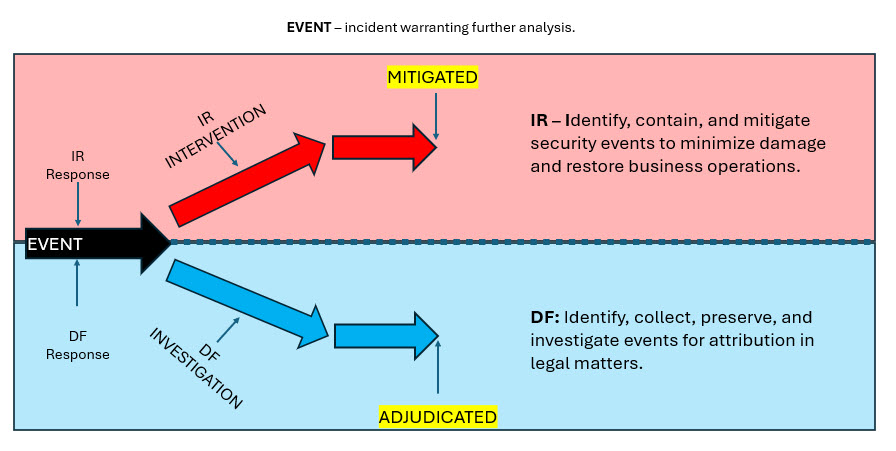
This divergence means DF roles prioritize accuracy and method, while IR demands flexibility and fast action. DF is retrospective, piecing together what happened, while IR is proactive, involving rapid decisions to contain threats. Both DF and IR may occur concurrently, sequentially, or independently, or even evolve into the other. Understanding these nuances is critical as they reflect fundamentally different disciplines within DFIR.
Moving Forward: A Balanced Approach
DFIR needs structure. An organization that sets job titles, training standards, and certifications would create more transparent career paths and help employers know what to expect from candidates. But remember: while these standards are essential, real-world experience must remain a cornerstone. Some of the best DFIR professionals I’ve met came up through non-traditional paths, learning through hands-on work and developing skills you can’t get from a degree. The field was largely developed by practitioners without any related formal education, let alone having any cybersecurity degree. We don’t want to lose out on learning from their experiences.
Both formal education and practical experience have their place in DFIR. This field should embrace both—building strong foundations with standard training while recognizing the value of real-world experience that keeps us agile and prepared for whatever digital threats come next.
In DFIR, a structured career pathway could be developed, such as the nursing field, offering tiers that range from entry-level roles requiring minimal formal education to advanced positions for doctorate-level scientists. This structure would allow individuals to enter the field with basic skills, such as data acquisition and preliminary analysis (ie: triage), and then progress through specialized training and education to more complex roles.
For instance, an entry-level technician might focus on initial evidence collection, while mid-level practitioners with certifications and experience could handle more comprehensive analysis and investigative work. At the highest levels, DFIR professionals with advanced degrees or extensive knowledge and expertise in areas like digital forensics, artificial intelligence, or data science could lead research initiatives, develop new forensic techniques, and contribute to the academic and technical growth of the field. This model would create a clear and accessible career ladder, encouraging professional development and fostering a highly skilled workforce capable of addressing increasingly sophisticated cyber threats.
Warnings
- Don’t make this too complicated.
- Don’t create an unbalanced, unfair, or discriminatory gatekeeping system.
- Give credit where credit has been earned (experience, education, training, contributions).
Licensing
We’re going to need some licensing, not unlike any other profession. This licensing will require a certain level of experience and/or education, with testing and annual training. With that, everyone will know where they stand in applying for and hiring to fill positions and their career progression.
Licensing also needn’t be complicated. The key is to determine and test foundational knowledge, not doctorate-level expertise or extremely specific skills (unless the license is specific to extremely specific skills).
Imagine licenses for a “Digital Forensics Technician,” “Digital Forensics Analyst,” “Digital Forensics Specialist,” or “Digital Forensics Scientist,” each having tested for the license and gained the requisite training, education, and/or experience for that license. How much easier would it be to apply for positions and hire for positions given licensed candidates? Much like a Registered Nurse (RN) vs. a Certified Nursing Assistant (CNA). If you know the difference between a CNA and an RN, the career path is clear, and the hiring requirements are easy.
The question of who should set standards in DFIR is crucial, as each potential group brings its own biases and challenges:
Academia: If academic institutions take the lead, there may be an emphasis on degree-based requirements, which could make entry into DFIR overly academic and exclude highly capable practitioners without formal qualifications. While academia offers a structured approach to learning, its slower pace might struggle to keep up with the rapidly changing demands of DFIR.
Practitioners: If standards are set by current DFIR practitioners, the focus may shift toward hands-on experience, potentially downplaying formal education. This approach could foster a more adaptable workforce but risks a lack of consistency in foundational knowledge and skills, especially for new entrants.
Government: Government-led standardization could result in requirements that may not align well with DFIR’s practical realities. Regulations may be either too rigid or disconnected from the field’s needs. There’s also a risk that government standards could be challenging or prohibitively costly for some individuals or smaller organizations to meet, potentially stifling diversity in the field.
Vendors: Vendors of DFIR tools and technologies could have a strong financial incentive to shape standards, potentially leading to requirements that favor their own products and services. While vendors bring valuable insights into technological advancements, their influence could result in a conflict of interest, prioritizing profits over the best interests of the profession.
Non-Governmental Organizations (NGOs): NGOs may offer an independent approach, aiming to bridge the gap between academic, practical, and governmental perspectives. However, as many NGOs rely on funding (often from government, corporate sponsors, or vendors), they might face pressure that compromises their impartiality.
A collaborative approach is needed. That is the only way to ensure clarity, fairness, and effectiveness in DFIR. Considering the global nature of DFIR, this is also a serious consideration in cooperation within the various jurisdictions in countries as well as between countries.
Call to Action
It is time for DFIR to set standards that reflect our evolving field. Let’s push for the right blend of structure and flexibility, valuing all paths that lead to expertise in DFIR. The worst thing you can do is nothing and let others determine how we are governed in our careers.
For those of us in DFIR, where we already cut out teeth, have the degrees, tons of experience, and are simply keeping up with technology, none of this is important to us individually. But, it is important to the continuation, improvement, and betterment of the career field. We can leave it better than we found it. We can make it easier to enter. We can make it easier to hire. We can do all of this, but only if we want to.
Discover more from Brett's Ramblings
Subscribe to get the latest posts sent to your email.