
DFIR (as we use it) started as a hashtag.


DFIR (the label) started as a hashtag. It didn’t create digital forensics or incident response, but did create a dominant label for both that became a banner and a massive marketing umbrella. This results in the most dangerous word inside that umbrella being one of the most common:
“Attribution”
People hear “attribution” and assume a single standard. That assumption is wrong, and it’s where the term DFIR stops being merely inconvenient and becomes dangerous: same word, different mission, different standards, different risks.
The split (define it or stop saying it)
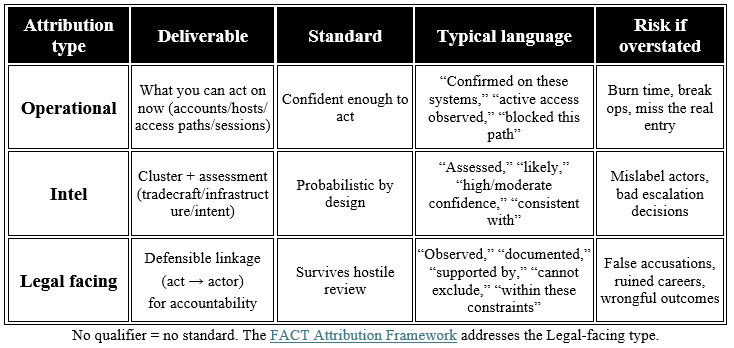
Inside “DFIR,” attribution can mean (at least!) three different attribution deliverables:
My intent (so nobody misunderstands my post)
This isn’t a tribal fight. It’s not “DF vs IR.” It’s not “cyber people don’t get it.”
It’s this: “DFIR” has become a convenient term that lets people imply a scope they don’t deliver. You know exactly what DFIR means (to you). But do you acknowledge that someone else sees something different in DFIR? We are not precise in our use of the term.
And being imprecise means those who suffer are students, new hires, teams in crisis, managers trying to staff realistically, and anyone unlucky enough to rely on an undefined claim. I’m not trying to kill the term. I’m trying to stop it from lying by omission.
Why the hashtag origin matters
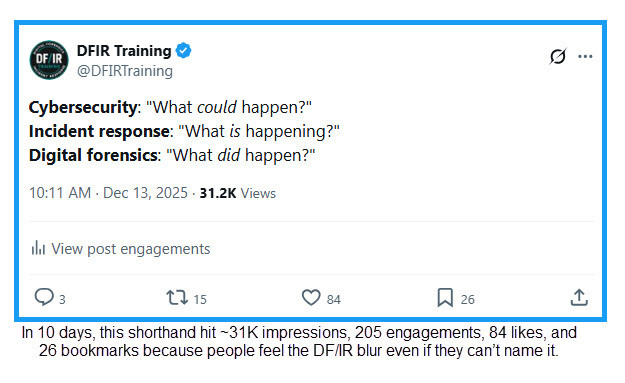
At one point, “#forensics” for DF and IR on Twitter was overly broad and crowded. The innovative #DFIR hashtag was created as a cleaner, single-stream filter so cybersecurity folks could find their people faster and reduce noise. This was an effective way to filter on Twitter, still to this day. The shared label accelerated information flow: Tools. Writeups. Lessons learned. Job leads. The community discovered itself at speed.
But we (DF, IR, “cyber”) were all placed in the same container, which eventually blurred the disciplines. Blurred disciplines produce blurred promises. That’s where we are today. The hashtag still works, and should continue to be effective. But let’s take it a step further.
The pivot we refuse to admit
Today, DFIR doesn’t mean one thing. It often means whatever the speaker needs it to mean in that moment (trainer, recruiter, vendor, manager, candidate, student). Everything downstream gets conflated under a single acronym:
- training catalogs
- degree tracks
- job descriptions
- performance expectations
- career paths
- role objectives
Same label. Different implied promises. Same confusion.
“I do DFIR” can describe jobs that barely overlap
When someone says “DFIR,” different audiences hear different missions:
- DF-leaning people hear ‘evidence, reconstruction, defensibility’
- IR-leaning people hear ‘containment, eradication, recovery’
- broader security hears ‘serious incident person’
None of those interpretations is wrong. The problem is treating them as the same job. Same scene. Different mission. Different tempo. Different constraints. Different definitions of success.
This isn’t a skills gap. It’s a definition problem that has become a culture problem.
Where the conflation does damage
1) Hiring
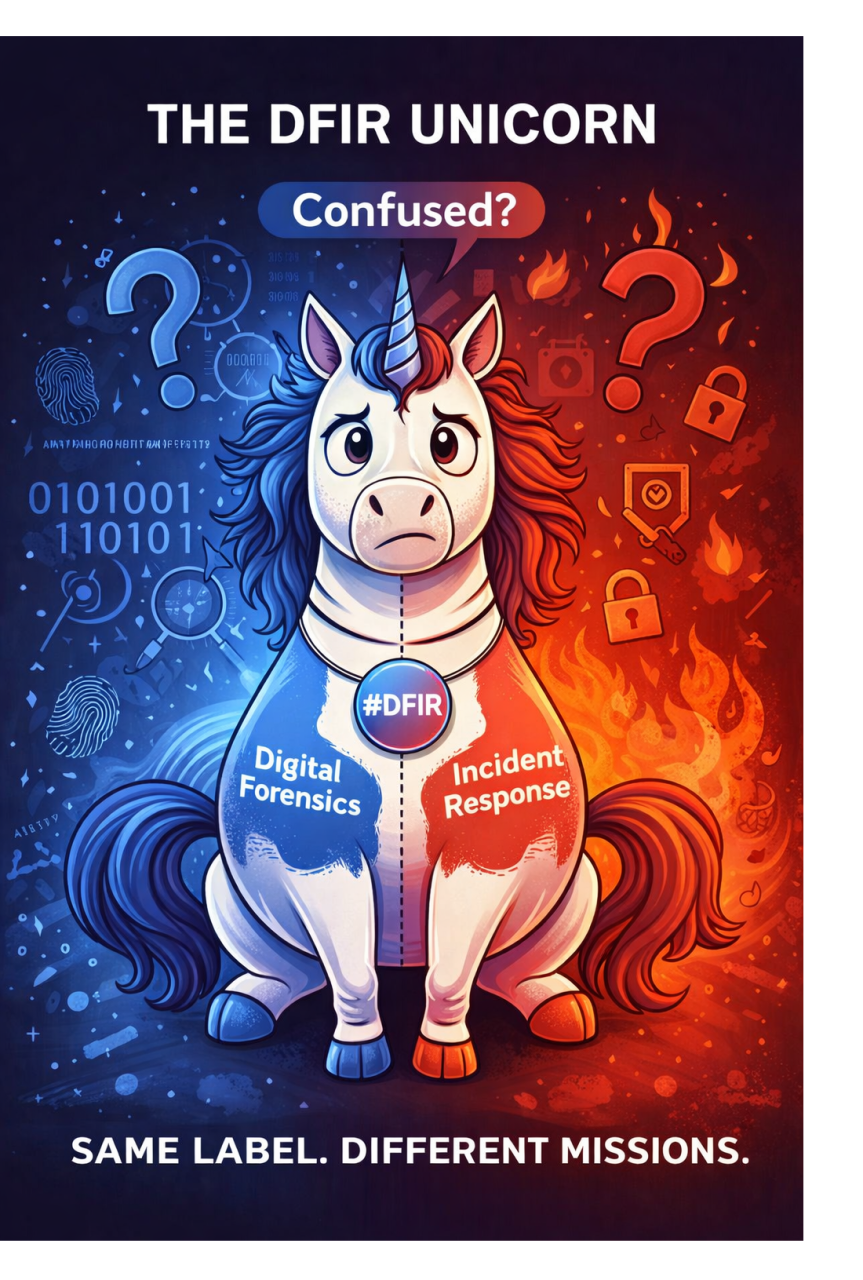
DFIR, as a comprehensive term, is the perfect unicorn word. It’s broad enough that every stakeholder projects their wishlist into the same posting:
- Security wants containment and scoping
- Leadership wants certainty and speed
- Legal wants defensible language and controlled disclosure
- Engineering wants prevention and hardening
- Someone uses “forensics” or “incident response” because it sounds serious
So, the posting becomes a wishlist instead of a realistic job. Candidates apply blind. Teams get mismatched. Everyone argues about what “good” looks like after the incident hits.
I once applied and interviewed for a DF role, only to find out during hour 3 that it was a pure IR role…re-reading the announcement during lunch confirmed it: A pure IR role advertised as a DF role. That was a disappointing day, as I wanted to work for that organization, but not in an IR role.
2) Training
A lot of “DFIR” training is either:
- IR-heavy with a forensics buzzword, or
- DF-heavy with an incident wrapper
Both can be good training. The failure is the implied promise: one label suggests end-to-end competence unless the course declares its lane. “DFIR” training as a description is precise only when it covers a shared foundational topic, not merely exposure to one side or the other.
I’ve taken plenty of DFIR courses to have experienced this enough to clarify with providers which lane the course is in before registration. These were expensive mistakes.
3) Education
Teaching DF deeply is hard. Teaching IR deeply is hard. Teaching both deeply with real labs, judgment pressure, and real trade-offs is expensive and rare. That’s not a moral failing. The failure is marketing a broad label that students interpret as a broad warranty.
I’ve spoken with 3rd-year students who, during the conversation, learned they selected the wrong “cyber” programs because the marketing was imprecise or overpromised about “DFIR.” That’s an expensive error.
One example where careers and cases get ruined: act → actor
A common failure mode under the DFIR umbrella on the DF side is leaping from activity to identity as if the intermediate steps don’t exist:
artifact → device → account → session → person
That attribution gap is full of things the industry underestimates:
- masquerading and shared credentials
- account takeovers
- false flags and planted artifacts
- partial telemetry and missing evidence
- interpretations that “fit” a story
If you can’t separate:
- what you observed vs what you inferred
- what corroborates vs what merely fits
- what alternatives you tested
- what limits you couldn’t overcome
…then you’re not working toward legal attribution. You’re doing storytelling with artifacts. Knowing your lane (am I DF or IR?) should be clearly defining your attribution objectives. Not knowing is when problems happen.
Here I go, stepping on a DFIR landmine…
DFIR without a slash is a forced marriage. It implies a single identity, a single role, and a single “all-in-one-done” definition that’s impossible to fill. The differences in attribution types is not just by definition, but by actual structure. What is the solution without stepping on toes?
Divorce?
A divorce fixes confusion (i.e., DF and IR as separate disciplines), but divorces are ugly: budgets split, teams fragment, and incidents don’t care about your org chart. And #DF or #IR hashtags are not going to be as effective as #DFIR has become.
A separation?
DF/IR is the acknowledgement that these are distinct missions that often share the same incident scene. They can cooperate. They can be staffed together. They can even be done by the same person, but only with explicit trade-offs. The slash isn’t punctuation. It’s a boundary. A subtle mental reminder that one is not the other. We did have the slash at least as far back as 2010, but Twitter hashtags don’t like slashes.
The fix: keep the umbrella DFIR and force the DF/IR qualifier
If the DFIR term is going to remain useful (and it will), it needs a constraint. Maybe we shouldn’t say “DFIR” without also specifying the lane and the output. Use DFIR like a folder name. Then label the contents. Examples:
- DF/IR (DF-led): defensible reconstruction; evidence handling; hostile-review reporting
- DF/IR (IR-led): containment/eradication/recovery; dwell-time reduction
- DF/IR (Hybrid/small team): explicit trade-offs; when preservation yields to urgency (and when it doesn’t)
- DF/IR (Attribution—intel): actor/campaign assessment with confidence language
- DF/IR (Attribution—legal): act→actor standards, alternatives tested, documented limits
This isn’t bureaucracy. This is honesty. One line prevents months (or a career) of confusion.
The DFIR honesty test
When you see DFIR in a course title, degree program, job posting, vendor pitch, or someone’s bio, ask:
- What is success here: containment, reconstruction, or identity?
If they can’t answer in plain language, the label is doing the selling. - When those goals conflict, what wins?
If the answer is “we do it all,” expect failure in real conditions. - What outputs do you hand to someone else when you’re done?
If outputs aren’t defined, the acronym is a fog machine.
Takeaway
The DFIR term didn’t become dominant because a committee defined it. It became dominant because the internet rewards labels that spread. A hashtag can organize a conversation. It cannot preserve a discipline. So, stop treating DFIR as a role that explains what someone actually does. Either:
- separate it (DF/IR, or DF, or IR, and enforce the qualifier rule), or
- explain it (DFIR only for the shared fundamentals that genuinely overlap)
Lane + output. Every time. Because the world already has enough confident stories.
Some links and things
FACT Attribution Framework: https://doi.org/10.5281/zenodo.17745958
X post: https://x.com/DFIRTraining/status/2000230941172843002
Since I’m talking about attribution, here is my contribution of an AI created-Brett directed attribution song titled Attribution is Everything.
Discover more from Brett's Ramblings
Subscribe to get the latest posts sent to your email.